
PLC Source vs Sink Training Interactive Tools
- Home >
- vocational-training >
- online >
- plc source sink
Free Online PLC Training: 4 PLC Source and Sink training interactive tools, PowerPoint and video.
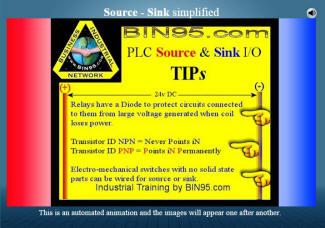
Please share this page with others on social media. The more people use these memory training tools, the more we will make. So please share with as many as you can. The last PLC data files post received many likes and shares. So, here’s another one: the PLC Source and Sink tutorials. You’ll find four different ways to learn about PLC sinking and sourcing inputs and outputs.
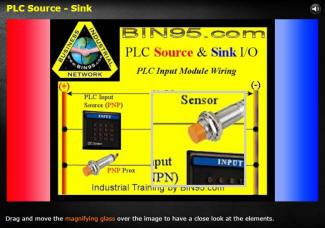
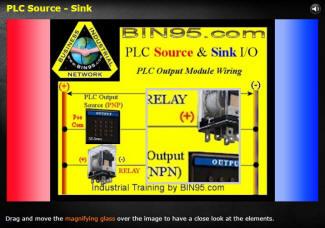
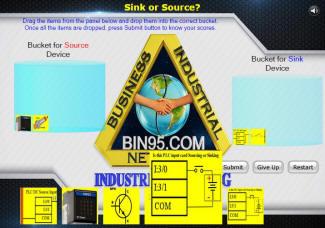
These four PLC source-sink training interactive tools are available for free online training. The first interactive "PLC Source Sink Slideshow" has a 27-second delay on each slide. This lets you study at your own pace. Even after narration, it may remain on a slide for a few more seconds. Steps 2 and 3 involve studying PLC input and output circuits in more detail. Step 4 is a fun little game to sort the pictures into their proper Source or Sink buckets. At the bottom of the page, there's a link to a PowerPoint presentation. It includes more detailed notes from the instructor. Followed by a link to the video and the test at the end.
Also, please leave a comment on any of our social media profiles below. Tell us what you think about this free PLC Source and Sink training tool. Additionally, please let us know what future topics you would like us to cover. (Thank you, Scott of GP, for requesting that we cover this topic.)
PLC Source Sink Home
🧠 Sinking vs. Sourcing PLC Inputs – FAQ
📘 What do “sinking” and “sourcing” mean in PLCs?
- Sinking: The device (e.g., PLC input) accepts current — it provides a path to ground.
- Sourcing: The device supplies current — it sends current to the load/input device.
⚡ How does current flow differ between the two?
| Configuration | Current Direction |
|---|---|
| Sinking | From load (+V) → PLC input → Ground |
| Sourcing | From PLC output (+V) → load → Ground |
🔌 Which devices are commonly used with each?
- Sinking Inputs: Often paired with PNP sensors, which source current.
- Sourcing Inputs: Typically used with NPN sensors, which sink current.
🔄 Can you mix sinking and sourcing in the same PLC system?
It’s possible, but it requires careful electrical isolation and compatible modules.
Most modern PLCs allow you to set input types for each module. But, mixing different types in the same module can cause problems.
🧰 How do I know which configuration I have?
- Check the PLC input module datasheet or wiring diagram.
- Examine how you wire the sensors and search for terms like “source/sink input type."
| Sinking | Negative (-V) wired to IO common terminal. |
| Sourcing | Positive (+V) wired to IO common terminal. |
❓ Which is safer or more reliable?
- Sourcing (PNP): Often safer in industrial settings—less risk of accidental grounding.
- Sinking (NPN): Common in legacy systems or Japanese-designed equipment.
🛠️ Are there troubleshooting differences?
- Sinking issues: Often caused by poor grounding or shielding problems.
- Sourcing issues: They might stem from overvoltage or shorts to ground.
🧪 How can I test the configuration?
- Use a multimeter to trace voltage flow:
- In sourcing: voltage should be present at the sensor output.
- In sinking: voltage should be present at the load side before reaching the input.