
Air Compressor Operation & Care
Compression theory, rotary screw and reciprocating machines, and preventive maintenance
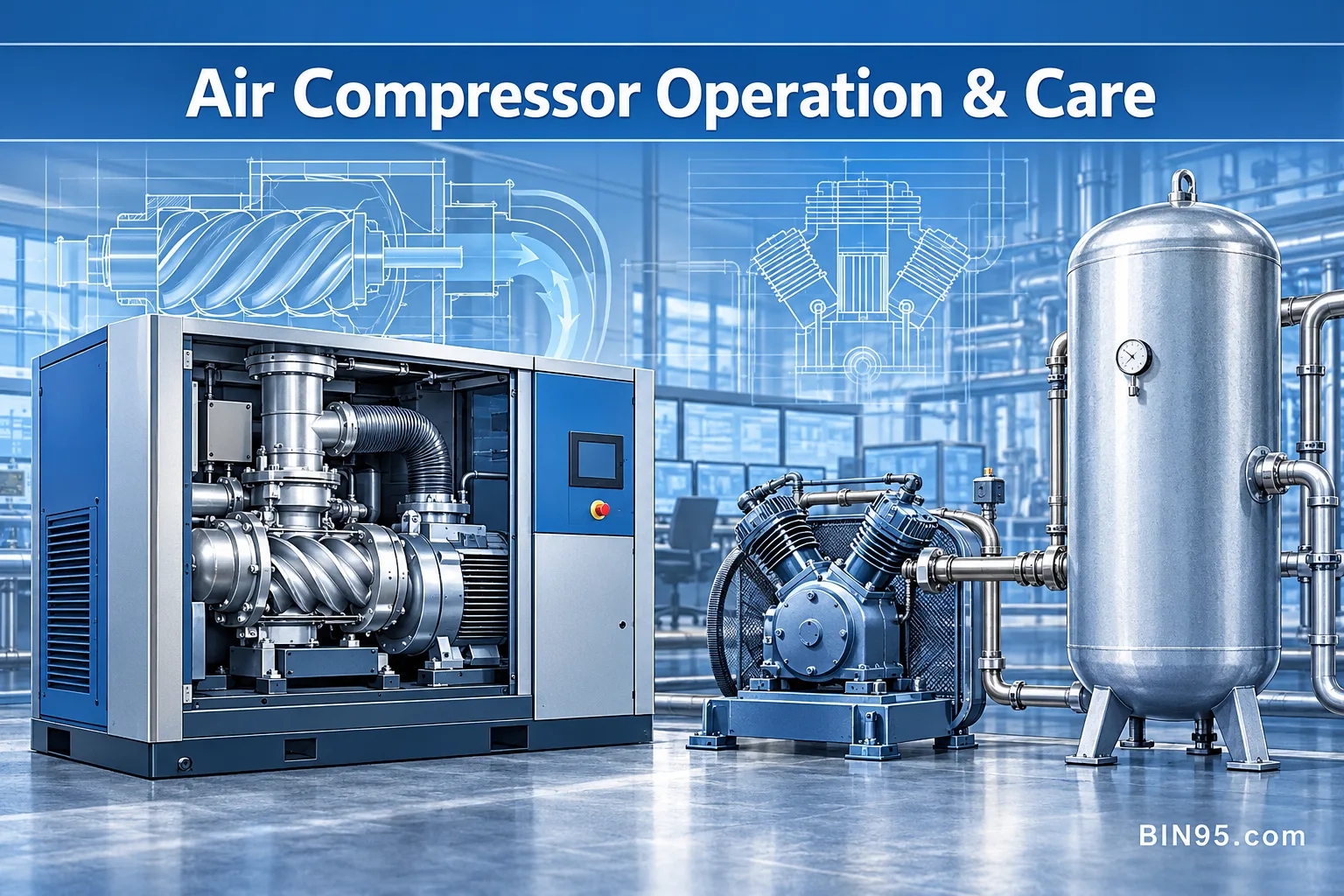
An air compressor uses mechanical work to raise air pressure. The compressed air stores useful energy, but compression also generates heat. Understanding that heat, the delivered airflow, and the machine's contamination controls helps technicians diagnose poor performance before a small fault becomes an expensive air-end or cylinder failure.
1. Why Compression Heats the Air
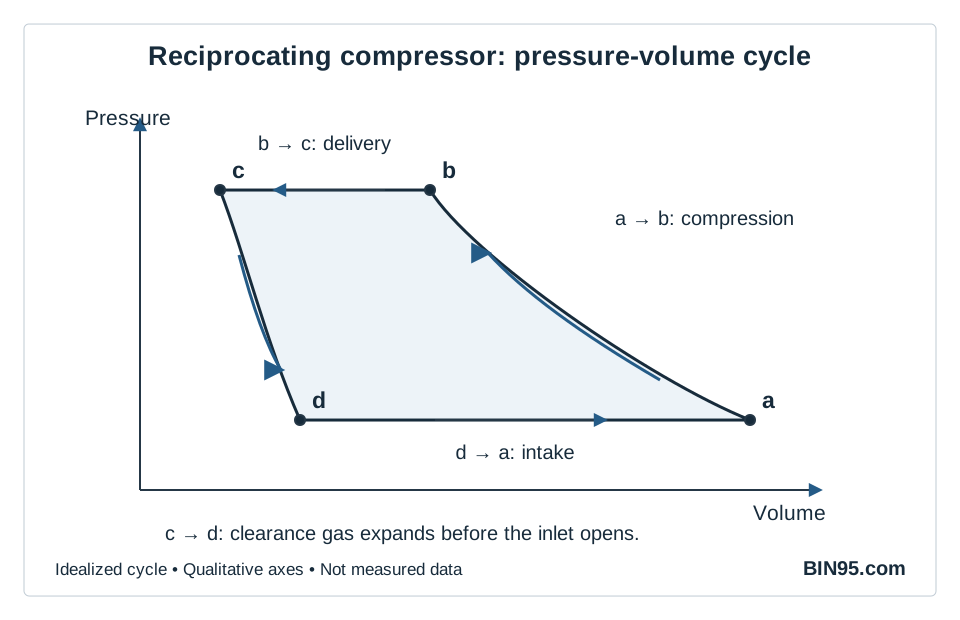
As the compressor reduces the space occupied by the air, pressure and temperature rise. A pressure-volume diagram represents the intake, compression, delivery, and clearance-gas expansion portions of a reciprocating cycle. The enclosed area relates to the indicated work for the cycle; it is not a direct reading of electrical power at the motor.
Discharge temperature depends on pressure ratio, cooling, staging, and machine condition. The source gives 150°C (302°F) as an illustrative hot discharge temperature, not an acceptable operating limit. Use the machine's alarm limits and operating manual when evaluating temperature.
2. Compare Free Air Delivery on the Same Basis
Free air delivery (FAD) expresses delivered air as an equivalent intake or reference-condition volume. It allows useful comparison only when the test basis, discharge pressure, and reference conditions are consistent. Check the supplier's stated rating rather than comparing unlike CFM figures.
The ebook uses approximately 1 bar absolute (14.5 psia) and 20°C (68°F) as a reference example. Actual published rating conditions can differ. Compare delivered flow and input power at the required pressure; displacement alone is not the same as useful delivered air.
3. Rotary Screw Compressor Operation
In an oil-injected screw compressor, meshing helical rotors trap air and progressively reduce its volume. Oil helps seal, cool, and lubricate the air end. The discharged air/oil mixture passes through separation equipment before the air continues into the system. Oil-free designs use different arrangements and must be maintained to their own instructions.
The source describes common plant-air pressures around 4–13 bar gauge (58–189 psig). These are examples, not a limit for every screw compressor. Internal clearances are small, so solid contamination can cause serious damage. Protect the intake, use the correct oil and filters, and investigate separator or oil carryover problems promptly.
4. Reciprocating Compressor Operation
A piston draws air through an inlet valve, compresses it, and delivers it through a discharge valve. Clearance gas left in the cylinder expands before the next intake begins. On many packaged units, pressure controls start, stop, or unload the machine; they do not directly command each cylinder discharge valve opening.
Check foundation and mounting condition when vibration changes. Inspect belts, pulleys, guards, lubrication, cooling, and valve condition as specified. Do not try to cure vibration by tightening anchors without checking alignment, mounting design, and the cause of the movement.
5. Cooling, Drying, and Condensate Removal
Aftercoolers remove compression heat. As air cools, water vapor can condense, so separators and drains must remove liquid before it reaches downstream equipment. Refrigerated dryers lower the air temperature to remove moisture. Desiccant dryers use a moisture-adsorbing medium to achieve a lower pressure dew point when required; activated carbon is generally used for contaminant adsorption rather than as the normal drying desiccant.
A failed receiver drain can leave water collecting inside the receiver. A drain that stays open wastes air. Check both failure modes and manage oily condensate through the site's approved treatment and disposal arrangements.
6. Troubleshooting Checklist
| Observation | Possible cause | Useful check |
|---|---|---|
| High discharge temperature | Fouled cooler, poor ventilation, cooling fault | Compare temperatures and inspect cooling paths |
| Oil carryover | Separator problem or unsuitable oil condition | Check oil level, separator condition, and operating history |
| Low delivered air | Intake restriction, leaks, worn components, control issue | Check pressure, flow, filters, and demand together |
| Excess vibration | Mounting, alignment, reciprocating or rotating fault | Inspect against the machine's condition baseline |
| Water downstream | Drain, separator, dryer, or dew-point problem | Verify actual drain operation and dryer performance |
7. Build the Maintenance Route
- Record normal pressure, temperature, load pattern, and operating hours.
- Check filters, lubricant, belts, cooling surfaces, and ventilation at the specified intervals.
- Prove that receiver and separator drains operate correctly.
- Trend abnormal noise, vibration, carryover, temperature, and pressure changes.
- Isolate electrical and stored-pressure energy before intrusive maintenance.
Receiver integrity is a separate requirement; see Unfired Pressure Vessel Inspections. For demand-side losses, continue with Compressed Air Waste Reduction.
Frequently Asked Questions
Why does an air compressor discharge hot air?
Mechanical work raises the pressure and temperature of the air. Cooling equipment removes part of that heat before downstream use.
What is free air delivery?
FAD expresses delivered airflow as an equivalent volume at stated reference conditions. Compare ratings only on a consistent pressure and reference basis.
Why check automatic receiver drains?
A blocked drain allows water to accumulate, while a drain stuck open wastes compressed air. Both reduce system reliability.
Adapted from original work by Mike Sondalini, Maintenance Engineer.
Source and Further Learning
Original ebook section: Air Compressor Operation & Care.
- General Air Compressor Training — Course covering compressor types and operating principles.
- Compressor Operation and Maintenance Assessment — Check your understanding with a short knowledge assessment.
Downloadable Version
Prefer a downloadable version? Get the full 72-page Process & Utilities Plant Essentials PDF below — ideal for employee or student handouts.
 Download right away in a printable PDF format!

$12.50