
Vertical Bulk Liquid Storage Tank Construction
Shells, roofs, floors, and foundations for aboveground liquid storage
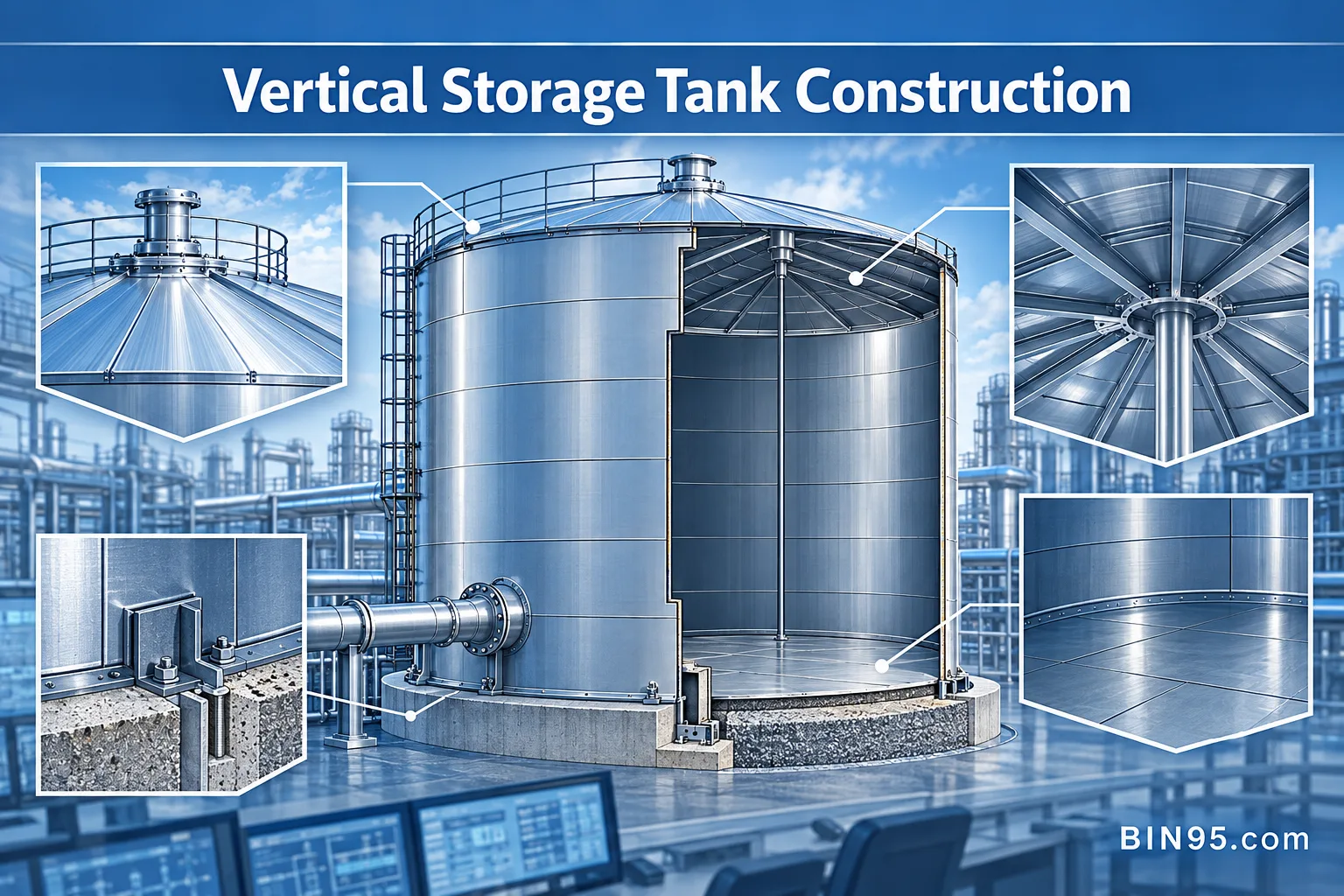
A vertical bulk liquid storage tank must support its own weight, contain the stored liquid, and withstand the loads imposed by its environment. Construction details that look minor—foundation fill, drainage, roof supports, and floor weld layout—can determine whether the tank remains reliable over decades of service.
This article covers the construction portion of the ebook's tank chapter. The companion Tank Maintenance & Inspection article covers deterioration, inspection, and continued service.
1. Select Materials for the Stored Liquid
Steel, alloy metals, fiberglass, plastics, and other materials can be used where their properties suit the service. Material selection must consider chemical compatibility, operating temperature, loading, fabrication, and the required service life. When the structural material cannot resist the contents by itself, an engineered lining may provide the internal corrosion barrier.
A lining is part of a complete system: surface preparation, application, cure, inspection, and repair access all matter. Selecting a compatible resin without controlling application quality will not provide reliable protection.
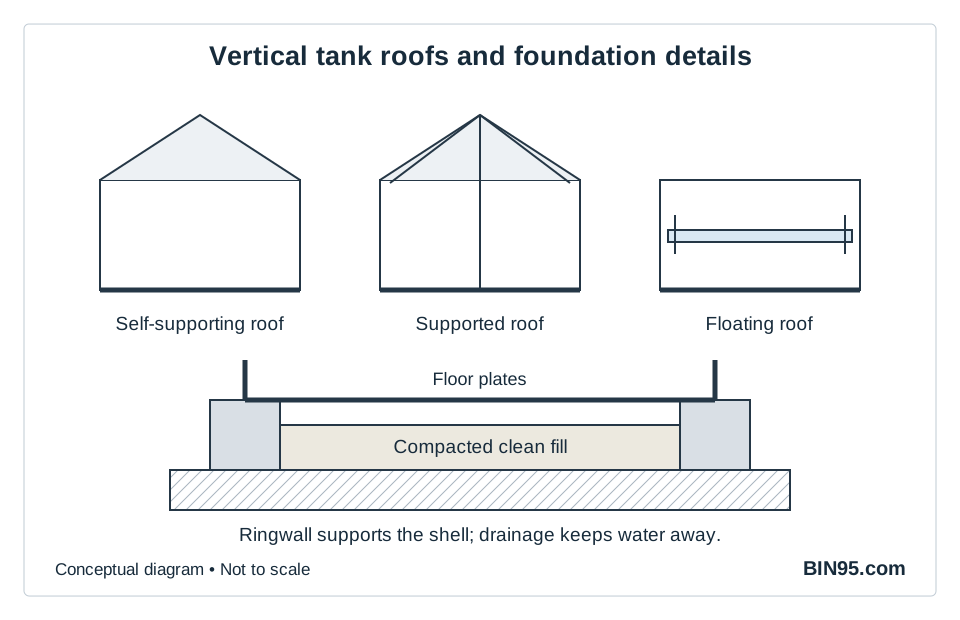
2. Understand the Tank's Design Basis
A recognized tank standard provides a framework for the selected material and service. API 650 addresses welded oil storage tanks within its scope; it is not a universal standard for every plastic, pressurized, or specialty chemical tank.
The designer establishes shell, floor, and roof thicknesses; weld details; nozzle reinforcement; supports; and allowances for the specified loads. Hydrostatic pressure increases with liquid depth, so the lower shell carries a different demand from the upper shell. Wind, seismic loading, roof live loads, rainfall, and possible vacuum also require evaluation.
Water used in a hydrostatic test can be denser than the normal stored product. A tank designed for a light liquid must still be evaluated for the approved hydrotest condition. Test filling, water quality, settlement monitoring, and disposal belong in the commissioning plan.
3. Match the Roof to the Service
| Roof arrangement | Main characteristic | Construction and operating consideration |
|---|---|---|
| Self-supporting cone or dome | Roof spans without internal columns | Shell and roof geometry must carry the specified loads |
| Supported fixed roof | Structural members support the roof | Supports and attachments need compatible corrosion protection |
| Floating roof | Roof moves with the liquid level | Seals, drainage, and movement need reliable access and clearance |
| Covered floating roof | Floating deck under a fixed cover | Both systems must be designed and maintained together |
Roof selection also depends on vapor management, product characteristics, emissions requirements, and weather exposure. A roof that appears similar from outside may have a very different internal support arrangement.
4. Floor Slopes and the Shell-to-Bottom Joint
Tank floors may slope toward the wall or toward a central collection sump. The slope determines where water, sediment, and contaminants accumulate. Drain and cleaning arrangements should remove these deposits without leaving a persistent corrosion zone at the critical shell-to-bottom connection.
The ebook emphasizes keeping weld intersections and other stress concentrations away from this heavily loaded joint. Actual weld spacing and repair details must follow the applicable design or repair standard. Its illustrative 300 mm (11.8 in) discussion is not a universal fabrication tolerance.
5. Build a Foundation That Stays Dry and Stable
The foundation must support both distributed floor loading and the concentrated load beneath the shell. Large tanks commonly use a reinforced concrete ringwall with compacted material inside it. The ground below also needs adequate load-carrying capacity; a sound-looking surface can conceal a weak layer at depth.
Choose clean foundation materials that will not promote underside corrosion. Salt-contaminated fill can accelerate steel attack. Grade the surrounding area and provide drainage so water does not collect beneath the floor. A perimeter drain positioned too high can trap water instead of removing it.
Settlement is expected to some degree, but excessive or uneven settlement can distort the shell, overload nozzles, and stress bottom welds. Establish survey references and a monitoring plan before filling, rather than waiting for visible leaning or piping strain.
6. Construction Handover Checklist
- Verify the design basis, compatible materials, and approved drawings.
- Confirm foundation preparation, compaction records, drainage, and survey references.
- Inspect welds, nozzle reinforcement, roof supports, and floor details to the specified acceptance criteria.
- Complete required coating, lining, and discontinuity inspections.
- Perform the approved commissioning tests and preserve baseline measurements.
| Handover record | Why maintenance needs it |
|---|---|
| As-built drawings and material records | Identify what was actually installed |
| Weld examination and test reports | Establish fabrication acceptance |
| Floor and shell thickness baseline | Support future corrosion assessment |
| Coating and lining records | Support compatible repairs |
| Settlement survey | Provide a reference for later movement |
Good construction makes later inspection possible. Provide safe access to drains, vents, gauges, manways, and the perimeter so small defects can be found before they become major repairs.
Frequently Asked Questions
Does API 650 apply to every storage tank?
No. Use a design standard appropriate to the tank material, pressure, temperature, and service. API 650 applies to welded oil storage tanks within its scope.
Why is tank foundation drainage important?
Water retained beneath the tank can accelerate floor corrosion and undermine the foundation. Drainage should keep the underside dry without trapping water at the perimeter.
Why check the hydrotest load for a light-liquid tank?
Water can be denser than the normal product, so the hydrotest may create a higher liquid load. The approved design and test plan must account for that condition.
Adapted from original work by Mike Sondalini, Maintenance Engineer.
Source and Further Learning
Original ebook section: Vertical Bulk Liquid Storage Tank Construction and Maintenance — construction and foundations.
- Management Concepts and Ideas — Process safety and maintenance examples involving tanks, heat exchangers, and cooling towers.
- Principles of Applied Engineering for Maintenance Personnel — Supporting guidance on materials, protective coatings, corrosion, and fluid flow.
Downloadable Version
Prefer a downloadable version? Get the full 72-page Process & Utilities Plant Essentials PDF below — ideal for employee or student handouts.
 Download right away in a printable PDF format!

$12.50