
Tank Maintenance & Inspection
Find corrosion, settlement, lining damage, and failing auxiliary equipment
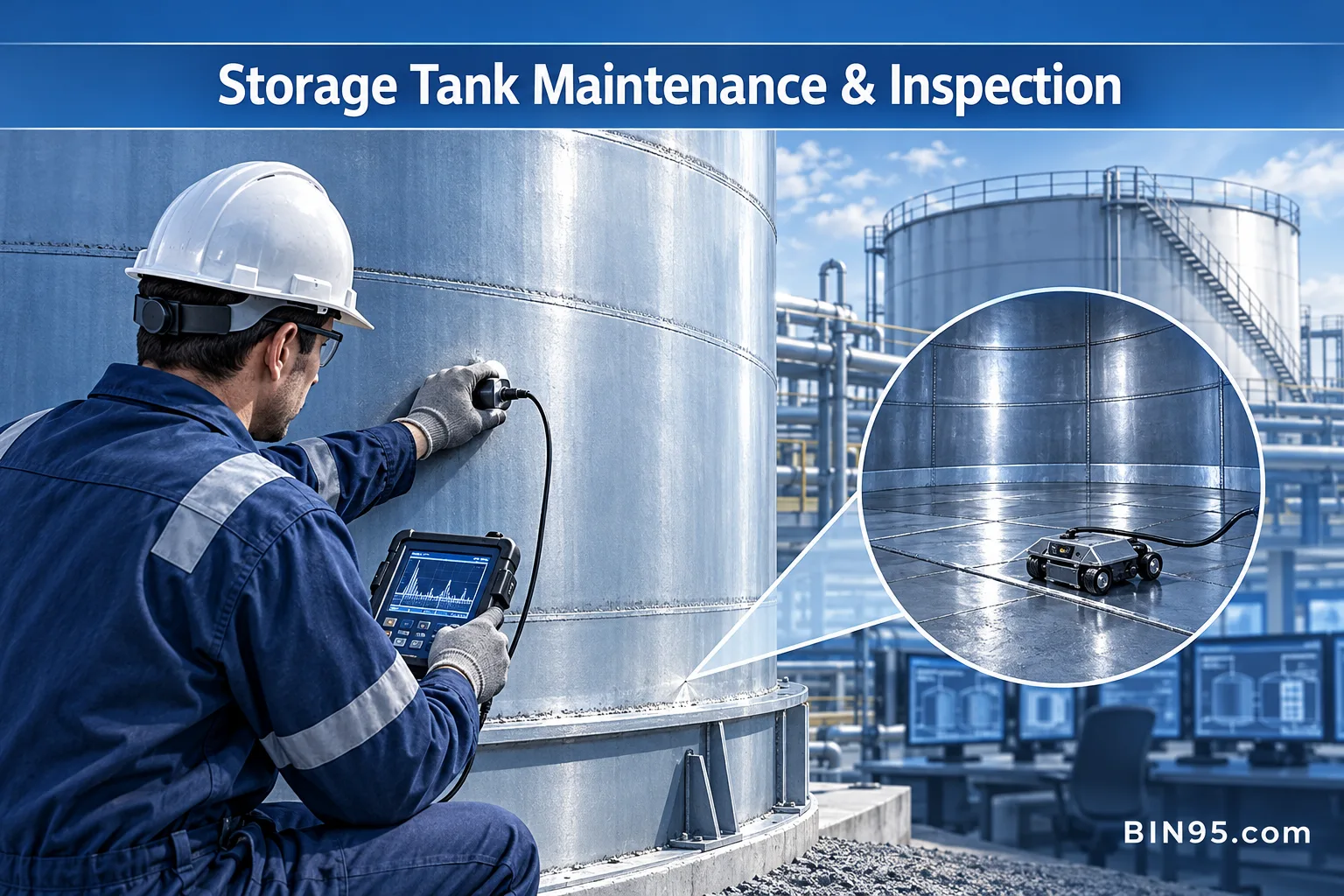
Storage tank maintenance protects the containment boundary, its foundation, and the devices that keep operation within the design limits. A good program combines routine external checks with planned internal inspections and measured corrosion trends. The objective is to detect deterioration early enough to repair it and make a defensible decision about continued service.
1. Start With the Tank's History
Gather the design standard, drawings, materials, stored products, temperature range, repairs, previous inspection reports, and baseline thickness readings. A change in product or operating conditions can change corrosion behavior. Review that change before assuming the old inspection plan remains adequate.
API 653 addresses inspection, repair, alteration, and reconstruction of tanks within its scope. The responsible inspector and engineer determine the applicable requirements. The ebook's historical fixed intervals and single minimum floor thickness are not universal acceptance rules; use the tank-specific assessment and governing requirements.
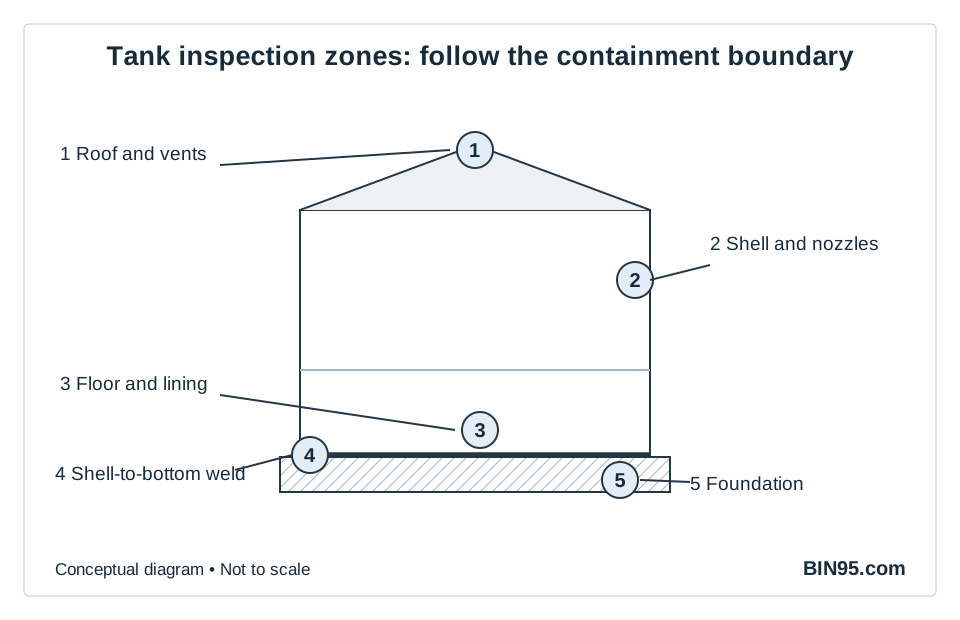
2. Keep Water and Debris Away From the Bottom
Debris lodged at the shell base or foundation crevice holds moisture and creates conditions for localized corrosion. Remove accumulated dirt, repair drainage, and inspect coating damage. Check that rainwater runs away rather than traveling beneath the floor.
Internal sediment can also retain corrosive liquid against floor plates and welds. A floor sloped to the wall may concentrate contaminants at the shell-to-bottom joint. Cleaning and inspection plans need to cover the actual collection zones, not just the easiest open areas.
3. Inspect Coatings, Welds, and Attachments
| Area | Look for | Follow-up |
|---|---|---|
| Shell and roof | Rusting, coating failure, deformation, leaks | Record location and assess the underlying metal |
| Shell-to-bottom connection | Corrosion, cracking, trapped deposits | Arrange qualified examination of suspect areas |
| Stairs, handrails, and attachments | Crevices, loose parts, corrosion | Repair to approved details and restore protection |
| Foundation and anchors | Settlement, cracking, loose or corroded anchors | Compare surveys and seek engineering assessment |
| Insulated shell | Wet insulation and corrosion evidence | Expose selected areas under an inspection plan |
An old coating recommendation is not automatically suitable for a modern lining system or for every chemical. Select compatible preparation, primer, and topcoat as a system. Repairs must address the cause of coating failure as well as the visible rust.
4. Use Complementary Inspection Methods
Magnetic flux leakage scanning can screen suitable steel floors for metal loss. Ultrasonic thickness measurements help confirm and quantify suspect locations. Shell and roof UT readings support corrosion trending when measurements are taken at documented, repeatable locations.
Vacuum-box testing checks accessible welds or floor areas for through-leaks under an approved procedure. It does not measure the remaining thickness. Surface examination, thickness testing, weld examination, and leak testing therefore complement each other rather than proving the same thing.
Internal linings need their own acceptance checks. A lining that appears intact can be thin, poorly bonded, or locally discontinuous. See Holiday Detection in Tank Bottom Linings for continuity-test limitations.
5. Plan Internal Inspection and Entry
The tank must be emptied, isolated, cleaned, and prepared for the inspection. Residues can conceal defects and create hazardous atmospheres. Establish the applicable confined-space entry controls, atmospheric testing, ventilation, rescue arrangements, and work permits before entry.
Expose enough surface to inspect the actual condition of the floor, welds, shell, and attachments. Map pits and thin areas rather than reporting only an average thickness. Suitability for continued service depends on the type, location, extent, and rate of deterioration—not simply whether the tank holds liquid today.
6. Include Auxiliary Equipment
Tank valves, level gauges, alarms, vents, pressure/vacuum relief devices, and instrument connections can fail independently of the shell. Verify function and calibration as appropriate. A blocked vent or incorrect level reading can create an operating hazard even when shell thickness is adequate.
Inspect nozzle corrosion and external piping loads. Settlement can move the tank relative to connected piping; leaks at a nozzle may therefore indicate a support or movement problem rather than a gasket problem alone.
7. Close the Inspection With a Service Decision
- Compare measured condition with the applicable acceptance criteria.
- Evaluate corrosion rate and the remaining corrosion allowance.
- Define repairs, operating restrictions, and any additional examination.
- Establish the next inspection date using the applicable code and tank condition.
- Retain defect maps, test results, repairs, and authorization for return to service.
Maintenance work is complete when the cause is controlled, repairs are accepted, and the records explain the next inspection plan. For the construction details behind these inspection points, see Vertical Storage Tank Construction.
Frequently Asked Questions
How often should a storage tank be inspected?
The interval depends on the applicable code, tank service, condition, corrosion history, and approved inspection program. A single fixed interval does not apply to every tank.
Does a vacuum-box test measure tank floor thickness?
No. It checks for through-leaks under the test procedure. Thickness measurements and other examinations are needed to assess metal loss.
What equipment belongs in a tank inspection program?
Include the shell, roof, floor, welds, foundation, anchors, linings, valves, vents, level instruments, alarms, and connected nozzles.
Adapted from original work by Mike Sondalini, Maintenance Engineer.
Source and Further Learning
Original ebook section: Vertical Bulk Liquid Storage Tank Construction and Maintenance — maintenance, inspections, and ancillary equipment.
- Principles of Applied Engineering for Maintenance Personnel — Supporting guidance on materials, protective coatings, corrosion, and fluid flow.
- Management Concepts and Ideas — Process safety and maintenance examples involving tanks, heat exchangers, and cooling towers.
Downloadable Version
Prefer a downloadable version? Get the full 72-page Process & Utilities Plant Essentials PDF below — ideal for employee or student handouts.
 Download right away in a printable PDF format!

$12.50