
Membrane & Leaf Filtration Overview
Filter cake, precoat, body feed, and troubleshooting pressure-leaf filters
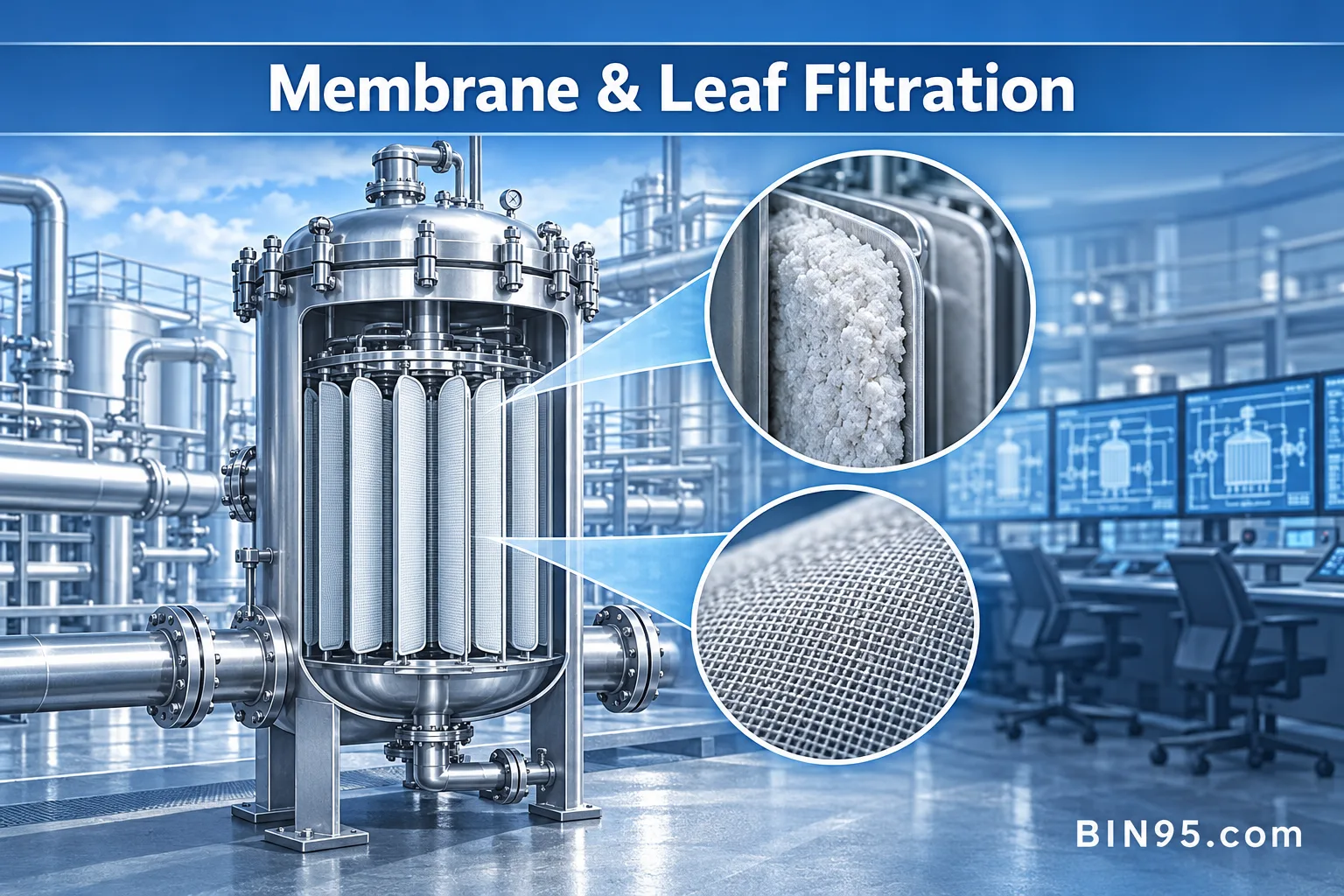
A leaf filter separates suspended solids from a fluid using supported filter media and, in many applications, a cake that builds on that support. The process works well when the media, contaminant, flow, and cleaning method are matched. A rapid rise in pressure drop or dirty filtrate indicates that one of those conditions has changed.
1. What the Original Chapter Means by Membrane
The ebook uses membrane in the broad sense of a porous cloth, paper, or screen that retains particles. This article follows that usage for cake and leaf filtration. Modern membrane processes such as reverse osmosis, ultrafiltration, and gas separation use more specialized separation mechanisms and are not interchangeable with pressure-leaf cake filtration.
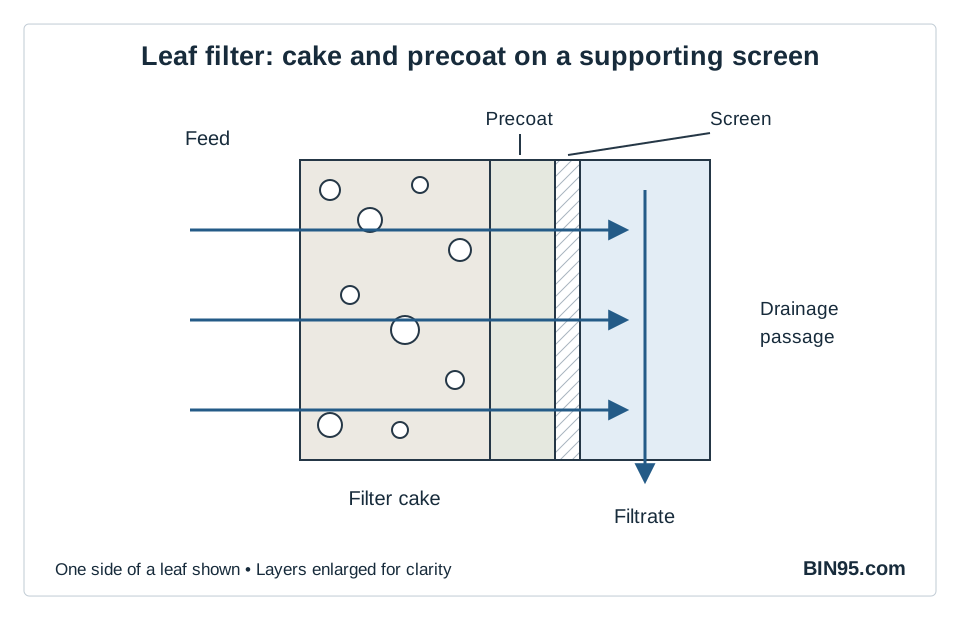
Leaf filters use multiple flat elements arranged inside a housing, often a pressure vessel. Circular elements may be supported on a shaft; other designs connect vertical leaves to a collection manifold. The support carries the media, while internal passages collect the filtrate.
2. How a Filter Cake Forms
At the start of a run, the screen or fabric retains material that can bridge its openings. As more solids accumulate, the deposited cake becomes an important filtering layer. The supporting screen then carries the cake and allows liquid to reach the clean-side outlet.
The particle shape matters. Long fibers can form a woven mat, while more granular particles build a bed with passages between neighboring particles. Very fine or gelatinous solids may blind the support before a useful permeable cake forms.
3. Precoat and Body Feed
A precoat is a layer of suitable filter aid deposited on the support before the main filtration run. It helps retain fine contaminants and can protect the support from rapid blinding. A body feed adds filter aid continuously to the incoming fluid so it becomes part of the growing cake.
Body feed can maintain more open flow passages in a cake that would otherwise become too resistant. Filter aid is not needed for every process; select it for the separation duty, product compatibility, disposal requirements, and equipment design.
| Arrangement | When it is used | Main control |
|---|---|---|
| Direct cake formation | Solids form a suitable permeable bed | Match media and flow to the particles |
| Precoat | Fine solids need a prepared filtering layer | Establish a uniform layer before the run |
| Body feed | Cake would otherwise become too resistant | Maintain the approved aid-to-solids relationship |
4. Control Flow and Differential Pressure
Adequate filter area keeps the velocity through the cake within the design range. Excessive local flow can disturb the cake or damage the media. As solids accumulate, the resistance rises; throughput and differential pressure show how the run is progressing.
Do not respond to every loss of flow by raising pressure. The vessel, leaves, media, seals, and cake all have limits. Compare the trend with the normal run profile and the manufacturer's stopping criteria. The acceptable pressure difference across a leaf can be much less than the housing pressure rating.
5. Troubleshoot the Observed Symptom
| Symptom | Possible cause | Check |
|---|---|---|
| Rapid pressure rise | Blinded media, unsuitable cake, excess solids | Examine the deposit, feed, and filter aid |
| Low flow after cleaning | Residual cake or blocked passages | Verify the complete cleaning sequence |
| Cloudy or silty filtrate | Torn media, poor seals, bypass, disturbed cake | Inspect leaves, manifold joints, and any shaft seals |
| Repeated screen rupture | Excess differential pressure, damage, chemical attack | Review limits, fabrication, handling, and compatibility |
| Uneven cake | Maldistribution or inconsistent feed | Check flow distribution and feed condition |
A scratch or crease can create a weak point in delicate screen wire. Inspect media during maintenance and replace damaged elements rather than trying to compensate with higher pressure. The screen-to-frame and leaf-to-manifold seals must stop bypass around the intended filtering layer.
6. Cleaning and Safe Opening
Depending on the design, cake may be discharged by vibration, rotation, wash sprays, or another specified method. Some housings require manual cleaning after opening. Chemical cleaning and hot flushing must be compatible with the media, seals, residue, and process.
Isolate, drain, depressurize, and verify zero stored pressure before opening the housing. A blocked gauge or plugged vent can conceal trapped pressure. Follow the equipment procedure, including its closure and interlock requirements.
7. Technician Checklist
- Confirm the required filtrate quality and the normal run trend.
- Check media condition, seals, filter aid, and feed consistency.
- Monitor flow and differential pressure against the approved limits.
- Investigate cloudy filtrate as a possible integrity or bypass fault.
- Clean and inspect the elements before the next run.
For pressure-retaining housing inspection, see Unfired Pressure Vessel Inspections. The original chapter also references Perry's Chemical Engineers' Handbook, sixth edition, for background on the filtration principles.
Frequently Asked Questions
What is a pressure leaf filter?
It uses supported filter elements inside a housing to retain solids while collecting filtrate through the clean side of the elements.
What is the difference between precoat and body feed?
Precoat forms an initial layer before filtration. Body feed adds filter aid continuously so it joins the growing cake.
What can cause cloudy filtrate?
Possible causes include damaged media, leaking leaf or manifold seals, bypass around the screen, or disturbance of the cake. Inspect the full clean-side flow path.
Adapted from original work by Mike Sondalini, Maintenance Engineer.
Source and Further Learning
Original ebook section: Membrane and leaf filtration overview.
- Mechanical Maintenance Technician Guide — Additional guidance on maintenance practices, air quality, and filtration.
- Industrial Maintenance Technology Guide — Related maintenance guidance on force, torque, stress, and filter performance.
Downloadable Version
Prefer a downloadable version? Get the full 72-page Process & Utilities Plant Essentials PDF below — ideal for employee or student handouts.
 Download right away in a printable PDF format!

$12.50