
Compressed Air Waste Reduction
Find leaks, correct poor connections, and lower pressure without disrupting production
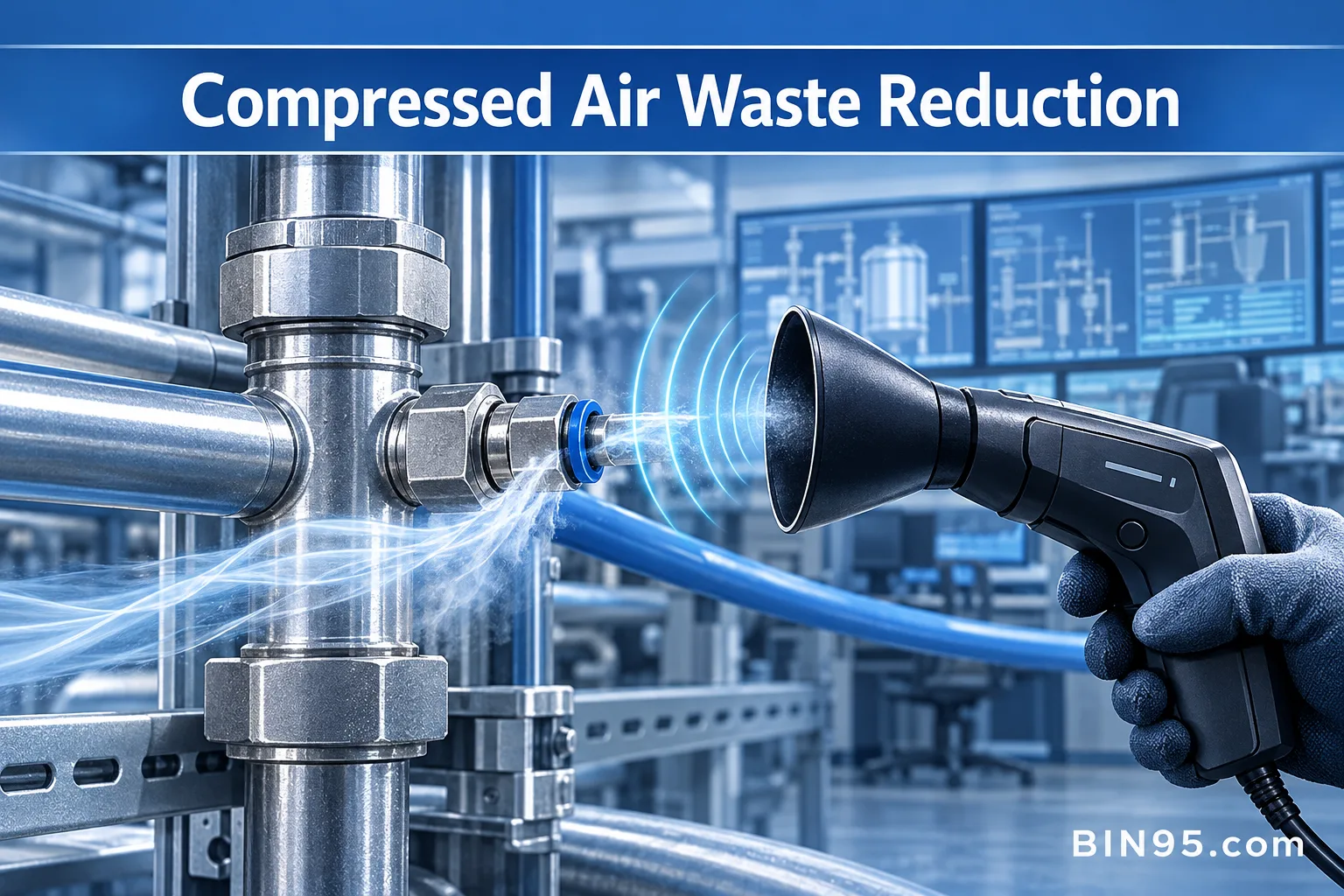
Compressed air leaks turn purchased electricity into no useful production. A plant may compensate by raising the pressure or running another compressor, masking the fault while increasing operating cost. Waste reduction begins by finding where air escapes, repairing the causes, and then checking whether compressor controls convert the reduced demand into lower energy use.
1. Inspect the Places Leaks Develop
The ebook identifies leaks throughout the distribution network, from mismatched threads to failed automatic drains. Include both the main system and the small connections at individual machines. A short damaged tube can waste air continuously even when its associated actuator is idle.
| Location | Common fault | Prevention or repair focus |
|---|---|---|
| Threaded joints | Loose, damaged, mismatched, or poorly sealed threads | Use compatible fittings and an approved assembly method |
| Push-in fittings and tubing | Scored ends, cracks, poor insertion | Replace damaged parts and prepare ends correctly |
| Flexible lines | Heat, UV, abrasion, weld spatter, or chemical attack | Reroute or protect with suitable rated materials |
| Valves and actuators | Stem leaks, passing seats, damaged seals | Repair the actual component and verify closure |
| Receivers and drains | Leaking fittings, drain stuck open | Maintain drains and examine receiver connections |
| Abandoned branches | Improvised closures or unnecessary live piping | Remove or permanently isolate by an approved method |
Bending a plastic tube over is not a permanent isolation method. It can crack and leak, and it leaves the branch vulnerable to accidental release. Use the designed isolation arrangement.
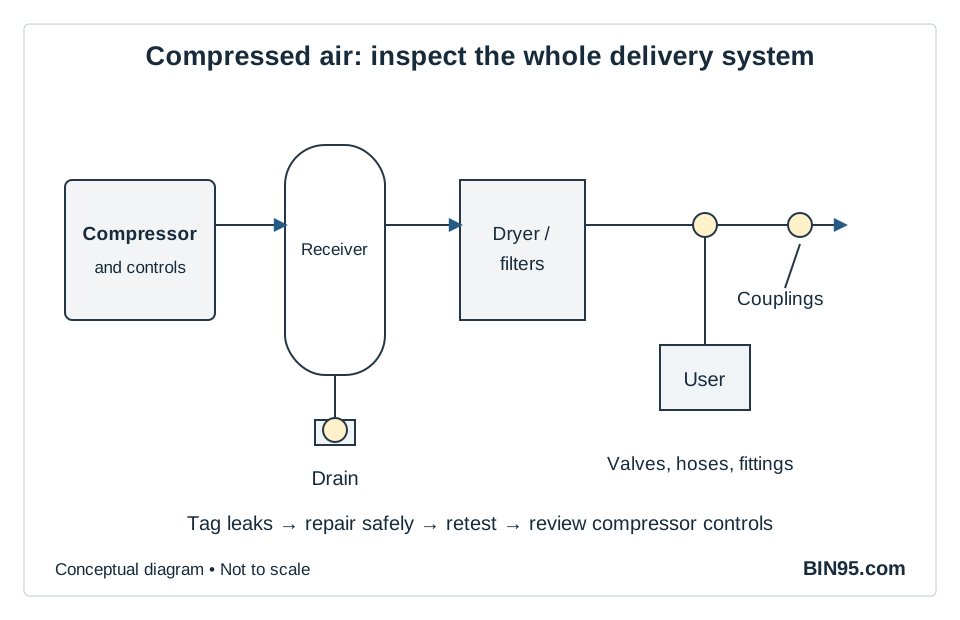
2. Find Leaks Systematically
Ultrasonic acoustic detectors help locate the high-frequency sound of escaping air in a noisy plant. A compatible leak-detection solution is useful for confirming accessible joints. Audible hissing can reveal large leaks, but hearing alone misses many smaller ones.
Assign an identification number to each leak. Record its location, component, operating pressure, estimated significance, and required repair. Photographs or a location sketch help the repair crew find the same point later. A survey without a repair list soon becomes an exercise in finding the same leaks again.
Conduct surveys at an interval suited to the system and revisit recurring problem areas. The ebook's annual survey is a starting example, not a reason to leave a known leak until the next year. Make reporting part of ordinary operating and maintenance rounds.
3. Prioritize, Repair, and Verify
Repair the most significant and accessible losses first, while considering production and safety constraints. Some leaks can be repaired during an approved local shutdown; others require a planned outage. Depressurize and isolate before opening components.
Retest every repair under the normal operating conditions. A quieter joint is not necessarily leak-free. Where repeated failures occur, examine vibration, unsupported tubing, incompatible materials, excessive temperature, and installation quality.
4. Improve Installation Standards
Good connections reduce both leakage and future maintenance. Specify fittings for the pressure, temperature, environment, and required air quality. Use qualified tubing or piping systems with appropriate joining methods, and provide access for inspection and repair.
The source advocates robust permanent connections for critical air supplies. The correct choice may be welded piping, approved mechanical connections, or instrument tubing, depending on service. Train installers to recognize thread standards and prevent cross-threading; see Sealing Threaded Connections Properly.
5. Reduce Pressure With Operations Involved
Higher pressure can increase leakage and unnecessary consumption at unregulated users. Before reducing the setpoint, establish the minimum pressure required at critical equipment during peak demand. Measure pressure near those users as well as at the compressor.
Correct excessive losses through undersized piping, dirty filters, dryers, and restrictive fittings. Raising the whole system pressure to overcome a local restriction increases cost elsewhere. Coordinate a controlled pressure trial with Operations, monitor the equipment response, and document the accepted settings.
6. Verify Energy Savings
Reduced air demand does not always reduce electrical power in direct proportion. Compressor control type, unload power, sequencing, storage, and the number of running machines affect the outcome. After repairing leaks, review controls and measure the actual system response.
For an illustrative annual calculation, a verified average reduction of 5 kW over 6,000 operating hours saves 30,000 kWh. At an assumed electricity rate of $0.12/kWh, that equals $3,600 per year. These are example inputs, not a promised saving or a universal leak-to-power conversion.
7. Technician Checklist
- Establish a baseline of pressure, airflow where measured, power, and production demand.
- Survey the full network and create a tagged repair list.
- Repair and retest leaks using approved isolation procedures.
- Correct weak installation details that cause repeat leaks.
- Review pressure and compressor controls, then measure the result.
Include compressor condition in the program: Air Compressor Operation & Care explains how filters, cooling, drains, and controls affect delivery.
Frequently Asked Questions
What is the best way to find compressed air leaks?
Use a systematic survey with an ultrasonic detector and confirm suitable accessible connections with approved leak-detection solution. Document and retest repairs.
Should I raise pressure when equipment is short of air?
First measure demand and pressure losses at the critical equipment. A local restriction or leak may be the cause; raising system pressure can increase waste.
Do leak repairs automatically produce proportional electricity savings?
No. Compressor controls and load behavior affect the result. Review the controls after repair and measure actual power reduction.
Adapted from original work by Mike Sondalini, Maintenance Engineer.
Source and Further Learning
Original ebook section: Plant compressed air waste control.
- General Air Compressor Training — Course covering compressor types and operating principles.
- Mechanical Maintenance Technician Guide — Additional guidance on maintenance practices, air quality, and filtration.
Downloadable Version
Prefer a downloadable version? Get the full 72-page Process & Utilities Plant Essentials PDF below — ideal for employee or student handouts.
 Download right away in a printable PDF format!

$12.50