
Holiday Detection in Tank Bottom Linings
What wet sponge testing finds—and why it does not replace lining thickness inspection

A holiday is a discontinuity in a protective lining, such as a pinhole or bare spot that exposes the substrate. In an aboveground storage tank, a small missed defect can leave the steel vulnerable to internal corrosion. Holiday detection checks lining continuity after application or repair, but it does not prove that every area has the specified dry film thickness.
1. Where Lining Holidays Develop
Air bubbles can burst as a coating cures, leaving small openings. Lining can pull thin at sharp edges and corners. Weld overhangs, spatter, pits, and difficult geometry can prevent complete coverage. These locations deserve particular attention during surface preparation, application, and inspection.
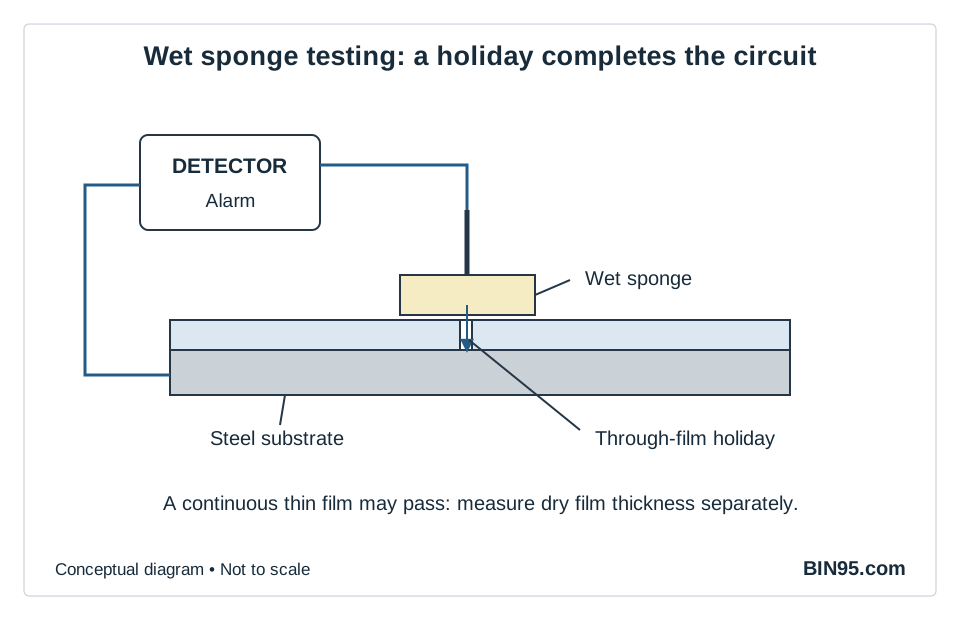
The original chapter focuses on low-voltage wet sponge detection. Its central lesson remains useful: a continuous but inadequately thin film can pass a continuity test and still fail prematurely in service. Visual inspection, dry film thickness measurement, and holiday testing answer different questions.
2. Select the Test Method for the Lining
Low-voltage wet sponge detectors are commonly used on relatively thin, nonconductive coatings over conductive substrates. High-voltage detectors are used for suitable thicker systems. The original chapter uses 20 mils as the dividing point; 20 mils equals 0.020 in, or 508 micrometers (about 0.51 mm).
Treat that thickness as a general method-selection guide, not an automatic voltage setting. The lining specification, applicable test standard, coating manufacturer's instructions, and instrument instructions determine the approved method and voltage. Excess voltage can damage a lining. Conductive coatings or special substrates need a procedure suited to their electrical properties.
| Inspection method | Main question answered | Important limitation |
|---|---|---|
| Visual inspection | Are there visible application defects? | Fine pinholes may be missed |
| Dry film thickness measurement | Is the coating thickness within specification? | Does not independently prove continuity everywhere |
| Low-voltage wet sponge test | Is there a conductive path through a discontinuity? | An intact thin film may not trigger the alarm |
| High-voltage holiday test | Are discontinuities detected by the approved high-voltage method? | Incorrect voltage or technique can damage the lining |
3. How a Wet Sponge Detector Works
The detector connects one lead to the conductive substrate and the other to a wetted sponge. As the sponge travels across the lining, water can contact exposed steel at a through-film defect. That completes the electrical circuit and produces an audible or visual indication.
Check the instrument's operation and ground connection before testing. The coating must be adequately cured and the surface prepared as the procedure requires. Use the specified wetting solution, contact pressure, and travel speed; a quick pass with poor contact can miss defects.
4. Avoid False Locations From Telegraphing
After the sponge wets a defect, a surface moisture trail can conduct current away from it. An alarm may then sound at a nearby location that has no through-film opening. This is called telegraphing.
Locate and mark the actual discontinuity, then dry the surrounding area as the procedure requires before continuing. Do not confuse repeated indications along a wet track with a string of new defects. Conversely, do not dismiss an alarm without confirming its cause.
5. Thin Film, Stripe Coating, and Repairs
An intact film can electrically insulate the steel even when it is too thin for the intended corrosion service. The ebook cites an illustrative thickness of 1 mil (0.001 in, 25.4 micrometers) to explain this limitation; that is not an acceptable lining specification.
Stripe coating applies an additional coat at vulnerable edges, welds, fasteners, and similar features before or within the full lining system, following the coating specification. It helps achieve coverage at locations where the main application can leave thin areas. It does not remove the need for thickness checks or discontinuity testing.
After repair, allow the required cure, verify the repaired thickness, and retest the affected area. Preserve a defect map and the repair history so acceptance is traceable.
6. Technician Checklist
- Confirm the lining system, substrate, specified thickness, cure, and test procedure.
- Select and verify the approved detector and voltage.
- Inspect systematically, including seams, edges, pits, and penetrations.
- Locate actual holidays and control surface moisture to avoid telegraphing.
- Repair, cure, recheck thickness, and retest before acceptance.
Testing inside a tank also requires the tank-entry and atmospheric controls appropriate to the work. Electrical testing must be authorized for the verified atmosphere. For the wider inspection program, see Tank Maintenance & Inspection.
Frequently Asked Questions
What is a holiday in a tank lining?
A holiday is a discontinuity, such as a pinhole or bare spot, that can expose the substrate through the protective lining.
Does passing a wet sponge test prove the lining is thick enough?
No. A continuous but thin lining may prevent an alarm. Dry film thickness must be checked separately.
What causes telegraphing during wet sponge testing?
A wet surface path can carry current from a real defect and trigger an indication away from the defect. Locate the opening and dry the area as the procedure requires.
Adapted from original work by John F. Delahunt. © 2001 Carmagen Engineering, Inc. All Rights Reserved.
Source and Further Learning
Original ebook section: Holiday Detection in Above-ground Tank Bottom Lining Inspection.
- Principles of Applied Engineering for Maintenance Personnel — Supporting guidance on materials, protective coatings, corrosion, and fluid flow.
Downloadable Version
Prefer a downloadable version? Get the full 72-page Process & Utilities Plant Essentials PDF below — ideal for employee or student handouts.
 Download right away in a printable PDF format!

$12.50