
Bolt Tension vs Nut Torque
Why friction changes preload—and why threads strip and bolts break
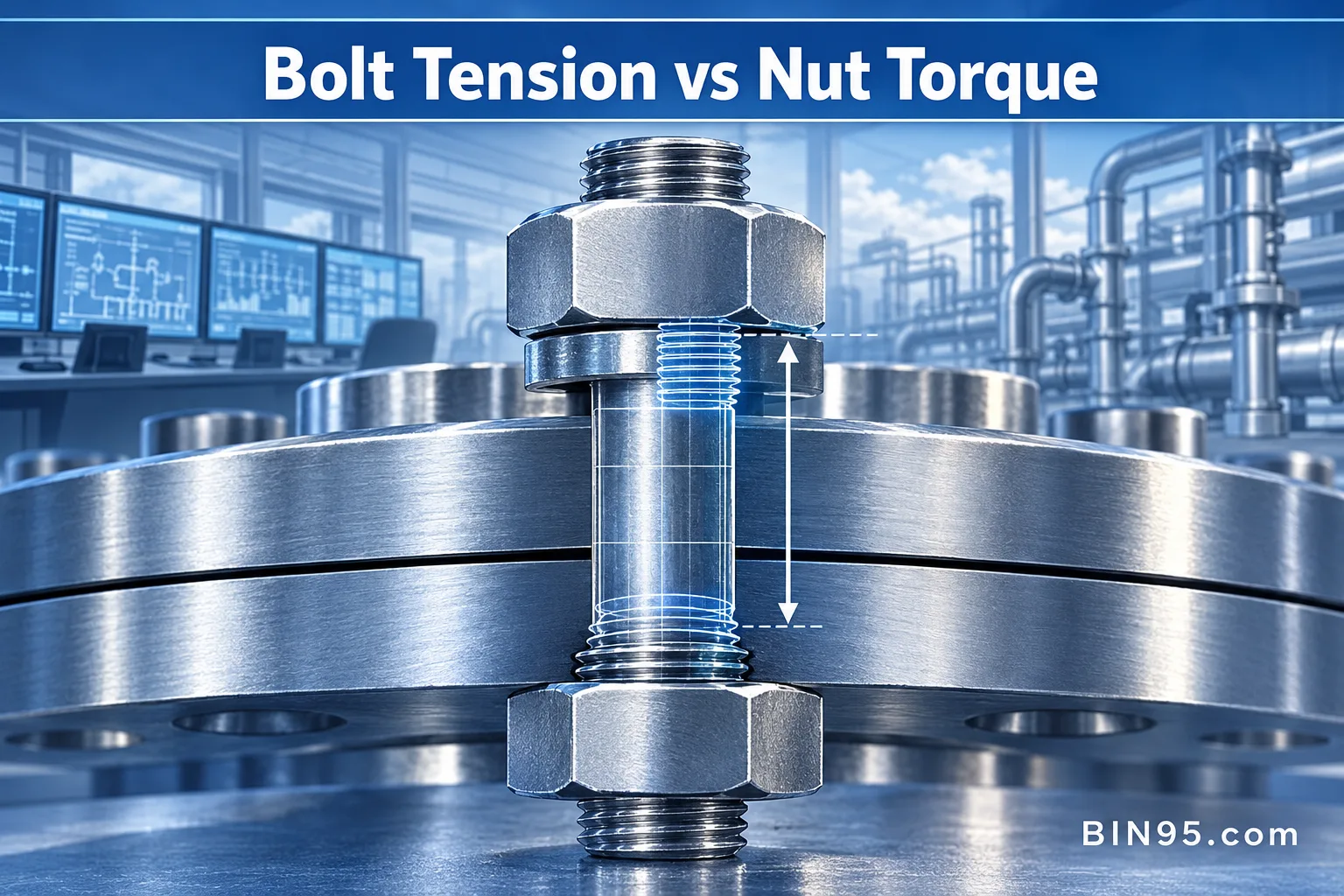
Bolt tension is the axial force stretching a fastener. Nut torque is the twisting moment applied during tightening. They are related, but a torque reading is an indirect estimate of preload because friction consumes much of the turning effort. This explains why two apparently identical bolts tightened to the same torque can carry different loads—and why changing lubricant without changing the procedure can break a bolt.
1. How Tightening Creates Bolt Tension
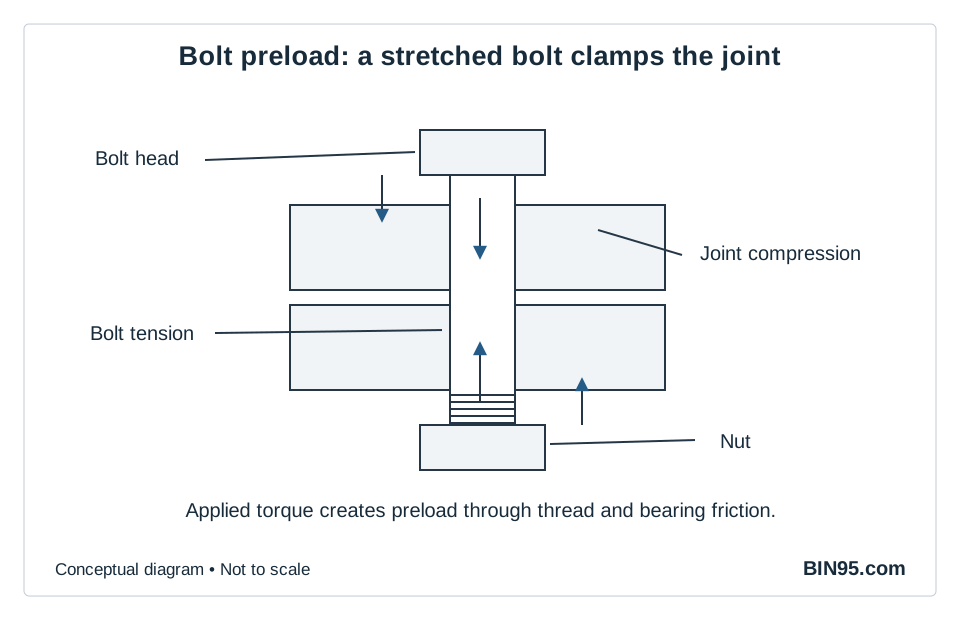
Before the nut seats, turning mainly advances it along the thread. After its bearing face contacts the joint, further rotation stretches the bolt and compresses the clamped parts. Within its elastic range, the shank behaves like a spring: it tries to return to its original length and pulls the joint together.
Thread deformation and joint compression also absorb some movement. The number of turns after snug therefore does not translate directly into bolt stretch unless the joint stiffness, grip length, and tightening procedure are understood. Consistent preload requires control of the complete assembly, not just the wrench setting.
2. Why Threads Strip and Bolts Break
As the nut advances, the bolt stress rises. Beyond yield, some stretch becomes permanent. Continued tightening can fracture the shank or a highly stressed thread root. If the engaged threads are weaker than the shank, the male or female threads may strip first.
A stronger bolt alone does not fix every stripped-thread problem. Check the nut grade, tapped material, engagement length, thread damage, and whether the specified lubricant was used. Replacing a damaged bolt while reusing a distorted nut can repeat the failure.
3. Friction Controls the Torque-to-Tension Relationship
The turning resistance comes from both sliding thread flanks and the bearing surface under the turning nut or bolt head. Roughness, coatings, corrosion, washers, and lubricant all change that resistance. At the same applied torque, a lower-friction assembly can develop more tension than a higher-friction assembly.
The original chapter illustrates the effect with the following friction ranges. These are historical examples, not torque correction factors or a substitute for fastener supplier data.
| Surface or lubricant from the source | Minimum coefficient | Maximum coefficient |
|---|---|---|
| Bare passivated surface | 0.10 | 0.25 |
| Baked-on molybdenum disulfide film | 0.04 | 0.10 |
| Molycote G Paste | 0.04 | 0.09 |
| Water-based PTFE on molybdenum disulfide | 0.03 | 0.10 |
Do not apply an oil-based torque specification to a different coating or lubricant without approved correction data. Some fasteners are supplied for a specified dry or coated condition; adding oil to them can invalidate the tightening procedure. Use the surface condition specified for that particular assembly.
4. Turning the Bolt Versus Turning the Nut
When access prevents turning the nut, a technician may be tempted to turn the bolt instead. The bearing friction can change because the rotating contact is now under the bolt head. The same indicated torque may therefore produce a different preload. Use the approved method for the actual access arrangement and bearing surfaces.
An extension that changes the torque wrench's effective lever length can also change the applied torque. Tool calibration alone does not account for an unapproved extension, poor reaction support, or a different tightening technique.
5. Choosing a Preload-Control Method
Torque tightening is convenient and fast, but its accuracy depends on repeatable friction. Measuring elongation or using a qualified tensioning method can give better information about bolt load when the application justifies the additional equipment and time. Heating a bolt to create thermal expansion, mentioned in the original ebook, is a specialized engineered procedure and is not a general field tightening method.
| Method | What it controls or measures | Main limitation |
|---|---|---|
| Torque wrench | Applied turning moment | Friction affects resulting tension |
| Controlled turn after snug | Nut rotation after a defined starting condition | Requires a qualified joint procedure |
| Elongation measurement | Change in bolt length | Requires suitable access and reference length |
| Hydraulic tensioning | Applied axial load during tensioning | Final retained load depends on the assembly and procedure |
6. Technician Checklist
- Identify the bolt, nut, washers, material grades, and required engagement.
- Inspect threads and bearing surfaces; replace damaged components.
- Confirm the specified dry, coated, or lubricated condition.
- Use the approved tightening value, sequence, and load-control method.
- Record the tool and final results for critical joints.
For flange-specific gasket behavior and tightening patterns, continue with Flange Bolting-Up Practices. Reliable preload comes from a controlled assembly process, with the torque value as one part of that process.
Frequently Asked Questions
Is bolt torque the same as bolt tension?
No. Torque is a twisting moment; tension is the axial load stretching the bolt. Friction affects the relationship between them.
Why can lubrication cause a bolt to break?
Lower friction can produce greater bolt tension at the same torque. The tightening specification must match the approved lubricant and coating.
Can I turn the bolt instead of the nut?
Only when the approved procedure permits it. Changing the rotating bearing surface can change the torque needed for the required preload.
Adapted from original work by Mike Sondalini, Maintenance Engineer.
Source and Further Learning
Original ebook section: The connection between nut torque and bolt tension (Why threads strip and bolts break).
- Equipment Maintenance Best Practice Guide — Further guidance on bolted joints, gaskets, and threaded connections.
- Industrial Maintenance Technology Guide — Related maintenance guidance on force, torque, stress, and filter performance.
Downloadable Version
Prefer a downloadable version? Get the full 72-page Process & Utilities Plant Essentials PDF below — ideal for employee or student handouts.
 Download right away in a printable PDF format!

$12.50